

Republican candidates lost out on an estimated $117 million in donations during two periods last year in which fundraising emails were being aggressively labeled spam by Google’s Gmail, Microsoft Outlook and Yahoo, according to a bombshell study.
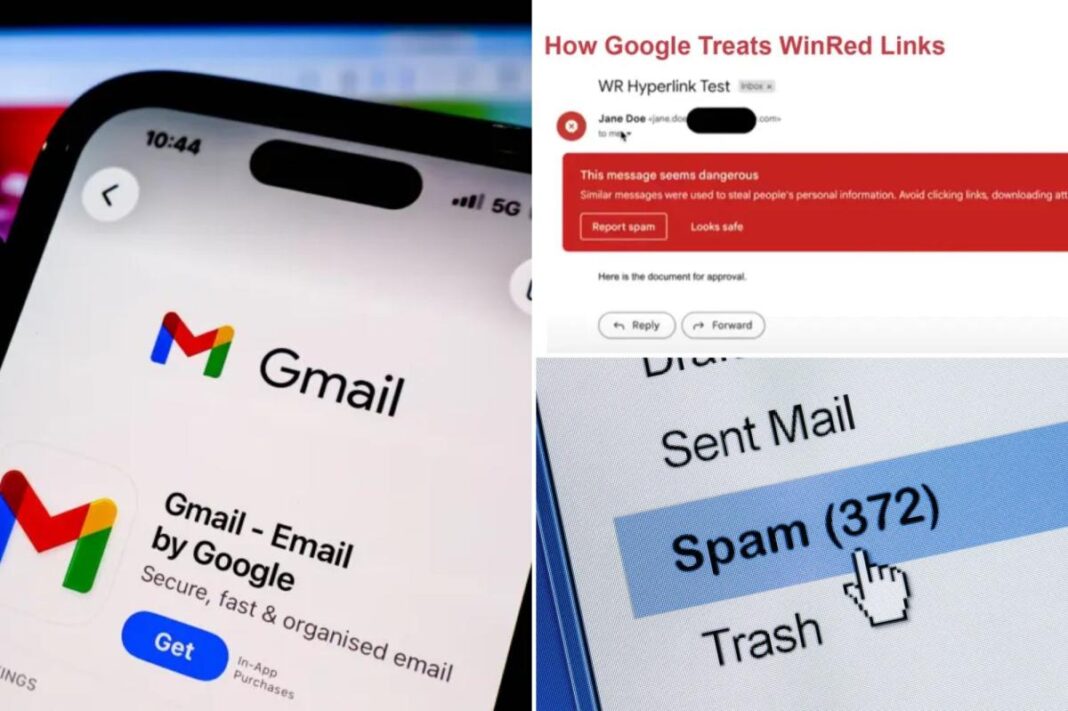
The first period identified by researchers ran from June 30th, 2025, when GOP consulting firm Targeted Victory first alerted Google that WinRed fundraising emails were being labeled as spam, through Sept. 15 of last year, when Google stopped using a popular spam “blacklist” that was improperly flagging emails, as The Post exclusively reported.
The problem wasn’t just limited to Gmail, the study revealed. Between those two dates, spam filtering tanked first-time donations on WinRed by a whopping 75% compared to normal levels across Gmail, Outlook and Yahoo.
A review of inbox-placement data showed a similar trend that took place on Outlook only from February through April of last year, when first-time WinRed donations plunged 83% compared to normal levels due to spam filtering.
Combined, the two periods in which WinRed fundraising emails weren’t hitting inboxes cost the GOP a total of 142,126 in expected first-time donations, the little-noticed study published on July 7 found. The researchers, Cameron Ellis of the University of Iowa and Lars Powell of the University of Alabama, estimated that those missing donations would have amounted to $117 million, based on a review of data from the Federal Election Commission.
The figure was significant when compared to reported fundraising totals by major Republican groups. The Republican National Committee, National Republican Congressional Committee (NRCC) and the National Republican Senatorial Committee (NRSC) raked in a combined $377 million in 2025.
The analysis could reignite long-running complaints by Republicans who have accused Google and other tech platforms of suppressing GOP fundraising efforts – while leaving similar ActBlue fundraising emails from Democrats untouched.
“It’s a pretty big number,” Powell said in an interview with The Post. “You can really think of that as an in-kind gift to ActBlue recipients.”
The study did not offer a conclusion as to whether the spam problem was the result of bias.
Instead, it concluded that “a narrow, link-level placement decision by a small number of mailbox providers produced a measurable and economically meaningful drop in political fundraising, and that the mechanism was observable only because private paired-test evidence leaked into public reporting.”
In other words, the major email providers cited in the study – of which Gmail is by far the most popular, with more than 3 billion monthly users – aren’t transparent enough about how their spam filters work and “we can’t read their minds,” Powell said.
When reached for comment, a Google spokesperson said the study “relies on deeply flawed methodology that fundamentally misunderstands how Gmail works.”
“Our spam protections apply equally to everyone, regardless of political affiliation and we encourage bulk senders to follow best practices to reach inboxes,” the spokesperson added. “Ultimately, people are in full control of their inboxes, with the power to mark messages as spam, block senders, or unsubscribe at any time.”
The Google spokesperson also pushed back on the $117 million figure, asserting that it was based on a theoretical estimate of donor value rather than specific real-world numbers.
Microsoft declined to comment. Yahoo did not return a request for comment.
The researchers’ findings were based on a comparison of itemized donation records from the Federal Election Commission, which were used to identify and separate first-time donors from repeat donors across WinRed and ActBlue.
Those figures were then matched against inbox placement rates during the two periods where emails were getting caught in spam filters to create an estimate of “missing” donations relative to normal levels of activity.
“Inbox placement data and paired email tests showed when the filtering happened and supported that WinRed links were the trigger,” Powell said.
While Microsoft’s Outlook is widely used in corporate environments, Google has long drawn outsized scrutiny from Republicans alleging censorship.
Google has repeatedly denied any wrongdoing or nefarious intent behind the spam-filtering issue. The Federal Election Commission dismissed an RNC complaint against Gmail in 2023, finding “no reason to believe” Google had violated the law. A federal judge in California also dismissed an RNC lawsuit against Google in a separate proceeding that took place in 2024.
Still, many Republican groups remain adamant that something strange is afoot.
“Google’s biased algorithms sidelined Republican fundraising emails for years while boosting Democrats’ donor outreach,” Bernadette Breslin, press secretary for the National Republican Senatorial Committee, told The Post.
“The NRSC has helped lead the investigation into Google’s suppression of mail to conservative subscribers, and this long-overdue update is a chance to level the playing field for online fundraising,” Breslin added.
Meanwhile, Google quietly made changes to Gmail’s settings in August. As part of a new program taking effect on on Tuesday, Google will allow political campaigns and PACs to enroll in a “verified sender program” that will allow them to bypass Gmail’s spam filters and reach inboxes at a higher rate – so long as they remain “policy-compliant.”
Powell, who has not had any communication with Google regarding the study’s findings, said the company may have felt compelled to act over fears that conservative backlash against Gmail would hit its bottom line.
“They make money by having people send more emails. If people start changing, that’s bad for their business model,” Powell said. “I think that’s when we find out whether they’re more blue or green.”
A GOP adviser who has observed the spam filter issue described the study’s findings as a “massive proof point in what we already knew to be true.”
“Smoking gun that conservatives are being systematically disenfranchised,” the adviser added.
Last August after The Post exclusively obtained a memo from Targeted Victory flagging concerns that fundraising emails were being marked as “dangerous.”
Targeted Victory conducted tests in which emails containing links ActBlue with the exact same text as Republican counterparts were delivered without issue.
Days later, FTC Chairman Andrew Ferguson cited The Post’s reporting in a letter to Google CEO Sundar Pichai, warning that any partisan leanings in Gmail’s spam filter would violate consumer protection laws.
By Sept. 15 of last year, Google had responded by scrapping its use of SURBL, a widely-used service that flags emails suspected of containing spam and prevents them from being delivered.
Ellis and Powell found that GOP email placement “normalized” after Google took that step.
Article credit and source