
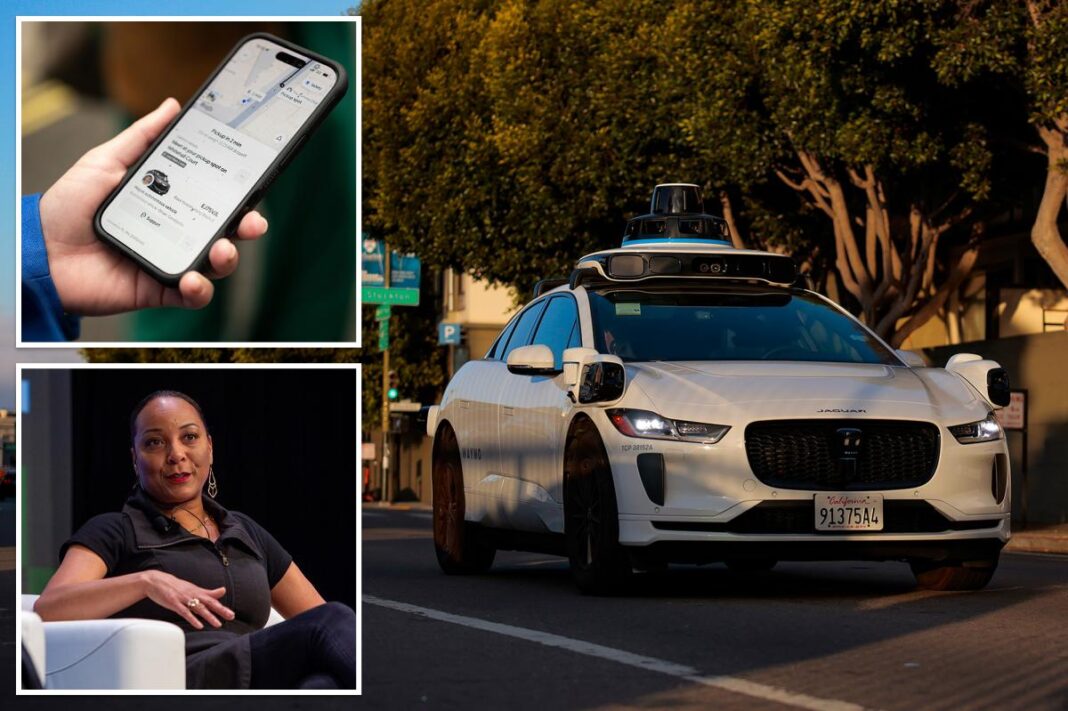


Waymo’s planned scrap of its partnership with Uber in two major markets comes as co-CEO of the self-driving juggernaut said riders’ ability to call an autonomous ride through the app was a “crapshoot.”
Tekedra Mawakana, who helps lead Alphabet’s Waymo, said her company’s plan to end an exclusive robotaxi partnership with Uber in Atlanta and Austin came after customer feedback for more consistency when ordering self-driving rides.
“In the early days, we would partner because we didn’t have the scale, and in that partnering, it was a little bit of a crapshoot. Will I get a Waymo? Will I not get a Waymo?,” Mawakana said in an interview with Bloomberg News’s Emily Chang.
The exclusive partnership – in which riders use Uber to hail autonomous Waymo vehicles – will sunset in January 2028, once Waymo begins to offer the service through its own app in those cities.
The comments shed light on the burgeoning rivalry between ride hailing platforms and makers of self-driving vehicles.
The moves are the latest indication that ride-hailing platforms like Uber and Lyft could potentially get cut out of the market – which some investors have long predicted – as makers of self-driving cars launch their own apps. Elon Musk’s Tesla has also sought to rely on its own robotaxi app rather than deepening ties with the ride-hailing networks.
Waymo – which operates roughly 4,000 vehicles across the US and does more than 500,000 trips per week in 14 cities – already offers rides through its own app in San Francisco and other markets, putting it in competition with Uber.
Mawakana said the decision to scrap the Uber partnership came after riders expressed difficulty with securing Waymos in Austin and Atlanta – even though they can indicate a preference for an autonomous vehicle in Uber’s app. She added that customers wanted a consistent offering from a single app.
“It’s important for us to have that relationship with the rider. We’ve gotten that feedback from the riders in those markets,” Mawakana said. “And at the same time, learning and partnering with Uber has been a really important part of our journey.”
Waymo and Uber didn’t immediately respond to requests for comment from The Post.
An Uber spokesperson told Bloomberg that the ride-hail company had inquired to Waymo about adding a self-driving ride option for Austin and Atlanta customers to more easily select that kind of trip, but Waymo declined.
As Waymo has expanded its robotaxi services, it has leveraged partners like Uber, Lyft and other fleet management companies.
The partnership moves come as Waymo is still trying to turn a profit in the capital intensive business of offering robotaxi rides. The company has invested big to grow its fleet, market presence and has poured money into research and development and maintenance costs.
Waymo rides cost more on average than cabs or human driven ride-hails.
The company has gone as far as to order Chinese cars to try to lower its cost. Waymo’s “Ojai” vans – which are on the streets of Los Angeles, San Francisco and Phoenix and have been aimed for Denver, Las Vegas and San Diego this fall – are a rebranded version of a vehicle made by Zeekr, a unit of the Chinese Communist Party-linked Geely Holding Group.
“Price is not the first priority,” Mawakana told Bloomberg. “We are not trying to have this race to the bottom on what we’re offering to our riders. We really want to elevate the experience over time.”
The self-driving car company is aiming to double the size of its fleet to 8,000 cars by the end of this year – up from its current level of roughly 4,000, Semafor reported, tapping into a $5 billion loan to help finance the expansion.
Waymo has also been weighed down by high-profile snarls – including vehicle log jams that have clogged San Francisco streets.
At the same time, the company has touted an improving safety record – including a reported collision rate in Los Angeles County that has plunged 41%—a drop largely driven by a federal rule change that allowed it to stop reporting certain minor wrecks.
Source link